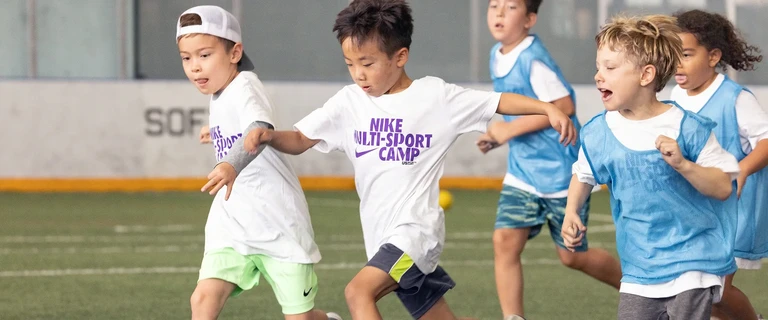
Multi-sport & Recreation Tip
How Sports Camps Build Confidence in Young Athletes
Sports camps build confidence by creating the conditions where young athletes experience real progress and have that progress witnessed and named by coaches who know how to make it land.
This is the outcome US Sports Camps has organized around since 1975. Across 20+ sports and more than 175,000 athletes every summer, the pattern is consistent enough to describe precisely: confidence is not a personality trait, it is a skill, and like every skill it develops through a specific kind of practice. Structured challenge. Honest feedback. Progress the athlete can see. An environment that makes effort feel safe.
Great camps are built to create all four. Here is how.
What Makes a Camp Environment Good for Athlete Confidence
The environment does more work than the drills do. Four conditions separate camps that build confidence from camps that are simply enjoyable.
Pressure is genuinely off. Unlike school teams, recreational leagues, or competitive club and travel programs, camp carries no consequence for failure. Club and travel programs are valuable in their own right, but they carry a specific kind of pressure: athletes are managing playing time, roster spots and results, often simultaneously. A bad week costs something. At camp it does not. Athletes can try new things, work on weaknesses, and take real risks without any threat to their standing. That single structural difference is the foundation everything else sits on.
Effort is the visible norm. Being surrounded by peers who are also working hard, also struggling, also getting better normalizes effort and removes the shame athletes sometimes attach to struggling. At camp, struggling is what everyone is doing.
Progress is made visible. An athlete who starts Monday unable to consistently make a free throw and ends Friday hitting seven out of ten has empirical evidence of their own development. That evidence outperforms any motivational speech.
The coach knows their name. Confidence requires being seen. A camp where an athlete is one of a hundred anonymous participants cannot deliver it regardless of how good the drills are. This is why athlete-to-coach ratio matters so much: for most youth sports, 8:1 to 12:1 allows a coach to actually know who they are working with. Across the US Sports Camps network, low ratios are treated as a quality standard rather than a nice-to-have.
The Signs a Camp Builds Confidence Instead of Pressure
Parents ask how to tell the difference before registering. These are the observable signals.
Signs it builds confidence:
- Coaches can describe what they do when an athlete makes a mistake, specifically
- Athletes are grouped by ability, so everyone is appropriately challenged
- The daily schedule includes reflection or review, not just training volume
- Success is described in terms of improvement rather than winning
- Fun is named as an explicit goal, not treated as a byproduct
- Beginners are welcomed by name in the program description
Signs it builds pressure:
- The program markets primarily on outcomes: champions, elite, showcase, exposure
- One group for everyone regardless of level
- No answer on how coaches handle athlete frustration
- Ratios above 15:1
- Evening programming is unstructured or absent at overnight camps
US Sports Camps programs are built around the first list. The organizing belief is that real development and genuine fun are not a tradeoff, and a camp that produces one at the expense of the other has failed at both.
What the Research Says
The relationship between youth sports participation and self-confidence is well documented. The Aspen Institute's Project Play research has found that young athletes who participate in structured sports programs report higher self-esteem, better resilience and stronger social competence than peers who do not participate in organized sport.
The American Academy of Pediatrics notes that sports participation supports healthy social-emotional development when the environment emphasizes effort, growth and enjoyment over pure performance outcomes. The key phrase is "when the environment." Not all sports environments build confidence. Some erode it. The difference is almost always the coaching.
Researchers studying youth sport psychology identify a "mastery motivational climate" as the strongest predictor of confidence development: improvement celebrated over outcomes, mistakes treated as learning rather than failure, and athletes psychologically safe enough to take risks. This is the climate US Sports Camps coaches are selected and supported to create.
How the Best Camps Coach Confidence
The coach is the architect. Everything else, the facility, the drills, the schedule, is infrastructure. The coach is the experience.
The coaches athletes remember for the rest of their lives share something: they believed in the athlete before the athlete believed in themselves. That belief shows up in specific, teachable behaviors.
They give real feedback, not just praise. Generic encouragement ("good job," "great effort") does not build confidence, because the athlete cannot repeat a performance they cannot identify. Specific feedback ("great first step on defense, you read the play early and recovered") tells an athlete exactly what worked and why it mattered. Memorable and repeatable.
They engineer successful repetitions. Confidence comes from competence and competence comes from reps. Skilled coaches structure practice so athletes experience real success at appropriately challenging tasks, not manufactured success. Each small win builds the internal sense of "I can do this."
They reframe failure as information. An athlete who tries something new and fails in front of peers has a choice about what that moment means. The coach's response determines which meaning sticks. Coaches who treat mistakes as a natural part of learning teach athletes to process failure without catastrophizing it, a skill that transfers well beyond sport.
They push past what the athlete thought was possible. The most vivid confidence moments at camp are not the easy ones. They are the moments an athlete did not think they could do something, struggled, and did it anyway. Knowing when to push and when to support is the craft.
US Sports Camps selects coaches on exactly this basis: experience, communication skills, teaching ability, and alignment with youth development best practices. The roster includes collegiate coaches at the D1, D2 and D3 levels, professional athletes and former Olympians, brought in for what they can teach as much as what they have done.
How Top Camps Stay Consistent Across Coaches
A parent's real worry is variance: what if we get a great camp and a bad coach?
The answer at a well-run network is not a standardized script. Coaches at US Sports Camps set their own curriculum and program structure, because the coaches are the experts and a template would flatten what makes them worth learning from. What is standardized is the expectation: how athletes are grouped, how feedback is given, what ratios are acceptable, how mistakes are handled, and what the culture should feel like.
When you are evaluating any camp, ask what is consistent across coaches and what is left to individual judgment. A program that has thought about this will answer immediately. A program that has not will describe either total uniformity, which usually means nobody is really coaching, or total variance, which means nobody is really responsible.
The Structure of a Confidence-Building Week
Confidence development is not accidental. It is the product of how the week is sequenced.
The daily progression matters. Strong camps move from individual skill work to small group drills to competitive games in a deliberate order. Athletes develop competence in controlled settings before applying skills under pressure, which means they enter competitive situations with something new to try rather than more of what they already know.
Visibility of progress creates belief. Daily reflection or informal skill assessment lets athletes see their own growth rather than being told about it.
The social environment reinforces identity. Shared struggle changes how athletes relate to challenge.
Evening programs build the whole athlete. The best overnight camps use evenings for team-building, reflective discussion and low-stakes social experiences that create friendships and belonging. Feeling part of something is one of the most reliable sources of confidence a young athlete has.
Confidence Looks Different in Different Sports
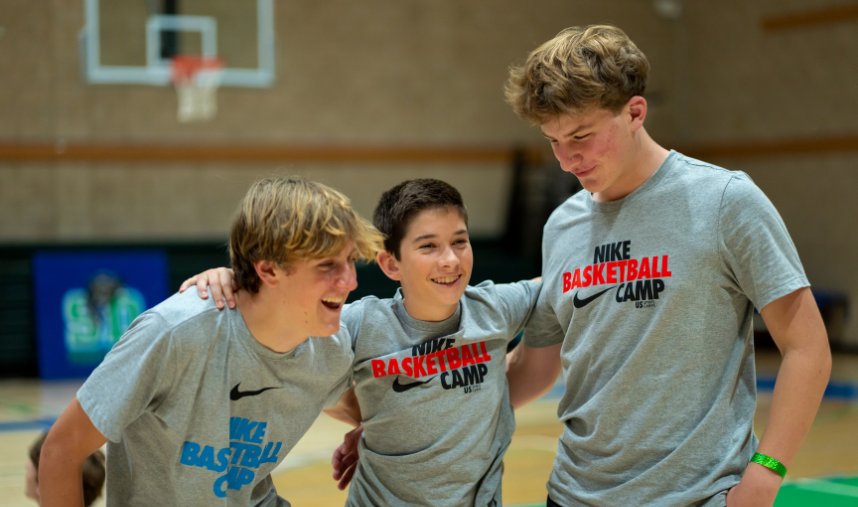
In basketball, confidence often lives in dribbling: whether an athlete trusts their ball handling under pressure. Camps that build dribbling repetitions until the ball feels like an extension of the hand, then test it competitively, produce a specific and durable kind of confidence.
In volleyball, confidence often lives in the serve. Serving is a solo act in front of everyone, and athletes who lack serving confidence can spiral fast. High-volume serving reps plus explicit coaching on managing solo pressure addresses this directly.
In soccer, confidence comes down to first touch. An athlete who trusts their first touch can receive the ball and immediately think about what to do next. An athlete who does not will always be a step behind.
In football, confidence is tied to physicality: trusting your body in contact. Proper technique taught in a safe, progressive environment builds physical confidence without recklessness.
US Sports Camps runs programs across 20+ sports, and coaches in each are chosen partly for understanding the confidence problem specific to their sport.
What Parents Can Do
The work coaches do at camp can be amplified or undone at home.
Ask about process, not outcomes. "How did you play?" builds a different mindset than "Did you win?" Process questions reinforce the mastery climate coaches are working to create.
Let them own the progress. The confidence belongs to the athlete. Resist narrating it for them; let them feel it and name it themselves.
Celebrate effort and courage. When you notice your athlete trying something hard or persisting through a struggle, say so. That is the behavior worth recognizing, regardless of outcome.
Stay curious about their coaching relationships. If a coach made an impression, ask what your athlete liked about how that coach worked with them. Helping them articulate what good coaching feels like builds their ability to seek it out.
Frequently Asked Questions
How quickly do athletes build confidence at camp?
Many experience noticeable shifts within a single week. The environment is designed to accelerate it: high-repetition skill work, expert feedback, and a social setting that normalizes effort. Across multiple summers, those gains become more durable.
What if my athlete is shy or nervous?
Common, and it typically resolves quickly once they are in the environment. If your athlete is particularly anxious, talk with the camp beforehand about what support they offer first-time campers. The best camps have staff focused specifically on helping nervous athletes feel welcome.
Does it matter how skilled my athlete is when they arrive?
Not at all. Confidence at camp comes from growth, not starting point. An athlete who arrives a beginner and makes real progress leaves more confident than one who arrives highly skilled and never challenges themselves. All-skills camps, which make up most US Sports Camps programs, are built for exactly this.
Does camp confidence transfer to other parts of life?
Yes. The AAP and youth development researchers consistently find that confidence built through structured athletic challenge, particularly trying something hard, failing, persisting and succeeding, transfers to academic, social and professional contexts.
It Starts Here
The confidence your athlete builds at a great sports camp is not a side effect. It is the point. The skills, the game-level improvements, the new friends are all real. But the athlete who walks off the field on the last day knowing they worked hard, pushed through something difficult, had a great time doing it, and got better: that is what lasts.
For over 50 years, US Sports Camps has helped athletes of all levels grow their game, build confidence, and love sport through safe, fun, and expertly coached camps.
Confidence and Fun Starts Here.
Sources: Aspen Institute Project Play (aspenprojectplay.org), American Academy of Pediatrics (aap.org), Journal of Sport & Exercise Psychology, US Sports Camps (ussportscamps.com)