Soccer Tip
How Soccer Camp Develops Young Athletes: Skills, Confidence, and Love of the Game

Parents want to know what camp actually produces, not what the schedule covers. The honest answer: a well-run soccer camp develops athletes across three dimensions at once. Technical skill, competitive confidence, and genuine love for the game.
Nike Soccer Camps, provided by US Sports Camps, have been doing this since 1975. Across 20+ sports and more than 175,000 athletes every summer, the mechanics are consistent enough to describe precisely. This guide explains how each dimension develops and what to expect.
The Technical Foundation Camp Accelerates
A week of soccer camp compresses more deliberate touches on the ball than most athletes accumulate in an entire competitive season. That concentration is one of the primary reasons camp accelerates development: four or five consecutive days of intentional practice creates skill gains that a once-weekly training session cannot replicate on the same timeline.
What gets addressed in concentrated fashion: ball control with both feet, passing precision and weight across different distances, dribbling combinations under light defensive pressure, shooting mechanics from different positions and angles, and 1v1 defending technique. Athletes who arrive inconsistent in any of these leave with enough repetitions to begin building real consistency.
US Sports Camps coaches structure the week so those repetitions land in a deliberate order rather than accumulating randomly.
The Tactical Layer Most Young Athletes Are Missing
Technical skill gets athletes on the field. Tactical understanding is what keeps them there as the game speeds up. Soccer camp is one of the few environments outside a high-level club program where young athletes receive genuine coaching on the tactical side.
In practice that means: how to press as a unit, when to switch the field, how to hold shape in transition, how to read an opposing defender before receiving the ball. Coaches who work at the collegiate or professional level bring a tactical vocabulary most youth coaches do not have time to develop. The US Sports Camps coaching roster includes collegiate coaches at the D1, D2 and D3 levels, professional athletes and former Olympians, which is why camp is often where a young athlete first encounters the game the way it works at higher levels.
What Makes a Camp Environment Good for Athlete Confidence
There is a pattern camp coaches describe across every sport: athletes arrive hesitant to attempt skills they have not fully mastered, and leave willing to try. That shift is environmental, not motivational.
Four conditions produce it:
Failure carries no cost. Camp is a genuinely different psychological context than a competitive match. Mistakes are not punished and experimentation is the entire point.
Effort is the visible norm. Everyone around the athlete is also working on something they are not good at yet.
Progress becomes visible. Enough repetitions in five days that improvement is measurable rather than asserted.
The coach knows the athlete by name. Confidence requires being seen, which is why athlete-to-coach ratio matters more than facility quality. Across the US Sports Camps network, low ratios are treated as a quality standard.
Research from the Aspen Institute's Project Play supports the mechanism: athletes who develop in positive, process-focused environments build the intrinsic motivation that sustains long-term sport participation. Camp builds confidence not by telling athletes they are great, but by giving them enough repetitions in a supportive environment that real competence grows.
How Coaches Turn Camp into a Confidence-Building Experience
The environment is the setup. The coach is what makes it work.
Specific feedback over generic praise. "Good job" produces nothing an athlete can repeat. "Great first touch there, you took it into space instead of stopping it" produces something they can do again on purpose.
Engineered successful repetitions. Real success at appropriately hard tasks, not manufactured success at easy ones. Calibrating that across a range of ability levels is the actual craft of camp coaching.
Mistakes reframed as information. An athlete who tries something new and fails in front of peers is deciding what that moment means. The coach's response determines which meaning sticks.
Pushing past the perceived ceiling. The most vivid confidence moments come from an athlete doing something they did not believe they could do. Knowing when to push and when to support requires reading the individual athlete, which requires knowing them.
US Sports Camps selects coaches substantially on these behaviors: experience, communication skills, teaching ability, and alignment with youth development best practices, with credentials as one factor among several. Coaches bring their own curriculum and session design; the standard they are held to is how the week feels from the athlete's side.
The Signs a Camp Builds Confidence Instead of Pressure
What to look for before registering:
Good signs
- The camp can describe specifically what coaches do when an athlete makes a mistake
- Athletes are grouped by ability so everyone is appropriately challenged
- Success is described in terms of improvement rather than results
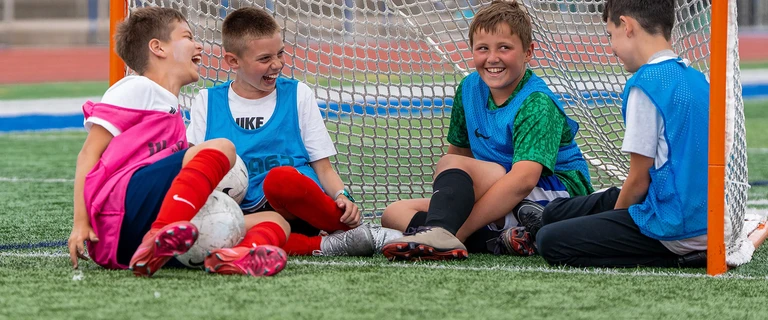
- Fun is named as an explicit goal, not treated as a byproduct
- Beginners are welcomed by name in the program description
- Athlete-to-coach ratios in the 8:1 to 12:1 range
Warning signs
- Marketing built entirely on outcomes: champions, showcase, exposure
- One group for everyone regardless of level
- No answer on how coaches handle athlete frustration
- Ratios above 15:1
- Unstructured or absent evening programming at overnight camps
The Difference Between Camp and Club Development
Club soccer develops athletes through competition. Camp develops athletes through instruction. Both matter and they do genuinely different things.
In a club or travel environment, athletes perform. They manage playing time, respond to competitive pressure, and adjust based on results. A bad week costs something real. At camp, athletes learn. They work on skills in isolation, receive individual coaching on technique, and experiment without risk to anything in the standings.
The athletes who benefit most from camp are often the ones whose club season has made them more cautious rather than less, because camp is exactly the environment where caution stops being useful. Many club coaches actively encourage their players to attend camp for this reason: it creates conditions where athletes work on the weaknesses they would not risk exposing during a competitive match.
This is also the clearest answer to "my athlete already plays club, is camp still worth it." Yes, and arguably more so.
Beyond Soccer: How This Works Across Sports
The mechanics described above are not soccer-specific. US Sports Camps runs programs across 20+ sports, and the development pattern holds in each, with the confidence problem taking a different shape depending on the sport.
Soccer: confidence lives in first touch. An athlete who trusts their first touch can receive the ball and immediately think about what to do next. One who does not will always be a step behind. Camps that focus relentlessly on touch quality build a specific, game-changing confidence.
Basketball: confidence lives in dribbling under pressure. Repetitions until the ball feels like an extension of the hand, then competitive situations that test it.
Volleyball: confidence lives in the serve, a solo act in front of everyone. High-volume serving repetitions plus explicit coaching on managing solo pressure.
Football: confidence is tied to physicality and trusting your body in contact. Proper technique taught in a safe, progressive environment builds it without recklessness.
Tennis: confidence lives in the second serve and in the willingness to construct a point rather than end it early.
Nike Sports Camps, provided by US Sports Camps, run across all of these, with coaches chosen partly for understanding the confidence problem specific to their sport.
What Parents Can Do to Support the Camp Experience
The most valuable thing a parent can do during camp week is resist the pull toward results. Pickup is not the time to ask whether they scored or whether their team won the scrimmage. It is the time to ask how they played, what they tried, what felt different from their normal training.
Open-ended, process-focused questions build the intrinsic motivation that makes camp work. Athletes who feel safe describing struggles and experiments come away with more than athletes who feel pressure to report back positively. According to the Aspen Institute's Project Play, the "ask how they played" approach reinforces mastery orientation, which is directly linked to long-term sport participation.
Frequently Asked Questions
How much can an athlete really improve in one week?
More than most parents expect on the technical side, because the repetition volume is so much higher than a normal training week. Tactical understanding and confidence often show the most visible change.
Is camp worth it if my athlete already plays club?
Often more worth it. Club develops through competition; camp develops through instruction. Club athletes frequently arrive at camp having become cautious, and camp is where that gets unwound.
What if my athlete is a beginner?
All-skills camps, which make up most US Sports Camps programs, group athletes by age and ability so beginners train with peers at their level. Camp is one of the better ways to try a sport without committing to a full season.
Day camp or overnight?
Depends on age and readiness more than on sport. Athletes 8 to 11 and first-timers usually do better with day camps. Athletes 12 and up who want total immersion get more from overnight programs.
Your Next Level Starts Here
A good week of soccer camp gives an athlete more touches than a month of training, a tactical vocabulary they did not have, and the specific confidence that comes from trying something hard in front of people and getting better at it.
For over 50 years, US Sports Camps has helped athletes of all levels grow their game, build confidence, and love sport through safe, fun, and expertly coached camps. Real development and genuine fun have never been a tradeoff.
Your Next Level Starts Here.
Visit ussportscamps.com/soccer to find programs near you.