Tip
How to Be a Better Goalkeeper: The Skills That Carry Across Soccer, Field Hockey, and Lacrosse
Nike Sports Camps, provided by US Sports Camps
Every team has one position where the job is different from everyone else's. The goalkeeper stands alone, faces the play, gets blamed for the goal, and is the only athlete on the field whose mistakes are measured on a scoreboard. It is a hard job to learn and a harder one to coach, partly because most coaching for keepers happens inside a single sport, as if the position were invented separately three times.
It was not. A goalkeeper in soccer, a goalkeeper in field hockey, and a goalie in lacrosse are solving the same problem with different tools. This guide covers what genuinely carries across all three, what does not, and how a young athlete gets better at the parts that matter most.
The Short Answer
Four things make a keeper better in any of the three sports, and they are not the four most people train:
- Set position and timing. Being balanced, loaded, and still at the instant the shooter strikes. This is the single most transferable skill in the position.
- Reading the shooter, not the ball. Hips and torso tell you where a shot is going before the ball does. By the time you are reacting to the ball, you are late.
- Angle and position. Being in the right place makes an ordinary save out of a spectacular one. Every sport rewards this and every sport has different distances.
- Communication. The saves you never have to make are the ones you organized away.
Reflexes matter, but less than people think, and they improve mostly by being trained inside the sport rather than with gadgets.
Why the Three Sports Are Not the Same Job
Before the transferable parts, it helps to be honest about the differences, because they are large and they start with geometry.
Sport | Goal opening | Mouth area |
|---|---|---|
Soccer (full size) | 24 ft wide by 8 ft high | about 192 square feet |
Field hockey | 12 ft wide by about 7 ft high | about 84 square feet |
Lacrosse (men's and women's) | 6 ft by 6 ft | about 36 square feet |
A soccer goal mouth is more than five times the area of a lacrosse goal mouth. That one fact explains most of the technical divergence. A soccer keeper has to travel, which is why soccer goalkeeping is full of footwork that covers ground. A lacrosse goalie works a small arc and lives on reaction and stick position. Field hockey sits in between, defending a modest goal against shots that can only legally come from inside the shooting circle.
What each keeper may do with their body differs just as much:
Soccer. Hands are legal, but only inside the keeper's own penalty area. Since July 2025, holding the ball for more than eight seconds concedes a corner kick to the other team, with the referee giving a visible five-second countdown (IFAB). Required equipment is the same as any field player: shin guards. Gloves and padding are optional but highly encouraged.
Field hockey. Inside the circle they are defending, and while holding the stick, goalkeepers may use the stick and the body to deflect or play the ball. Outside the circle, they may only use the stick. There is no catching and no throwing. The hand protectors deflect, they do not grip. Protective equipment is mandatory, with headgear, leg guards, and kickers as the stated minimum under the international rules; US high school and college rules require more, including a helmet with fixed facemask and throat protection.
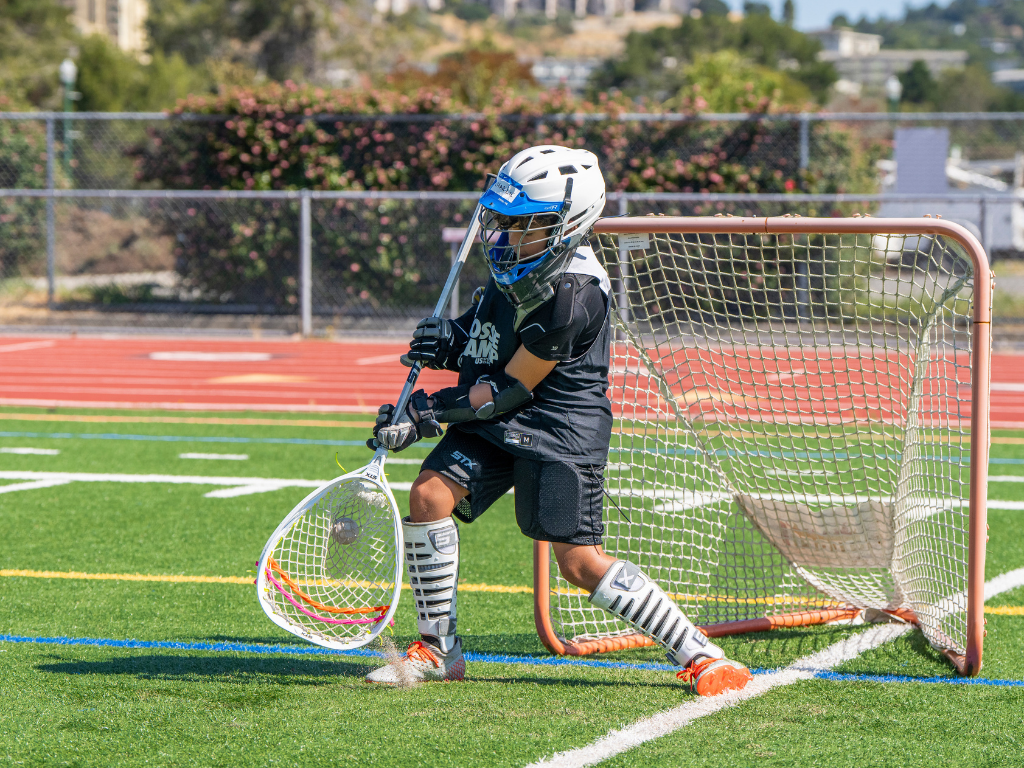
Lacrosse. The stick is the primary save tool, and the oversized goalie head exists for exactly that. A boys' or men's goalie may block or bat the ball with a hand but may not catch it. A girls' or women's goalie may stop the ball with a hand or body and must then put it in the stick. Chest protectors certified to the NOCSAE commotio cordis standard have been required for goalies in both the boys' and girls' game since 2021 (USA Lacrosse). The crease is protected space: no opponent may contact the goalie or the goalie's stick while the goalie is inside it, and possession in the crease is limited, four seconds in the men's game, ten seconds to clear in the women's.
Anyone telling a young athlete these are the same position is skipping the part where the rules decide the technique.
The Skills That Really Do Carry
Set position, and setting on the shooter's plant foot
This is the transfer that matters most, and it is the same in all three sports: an athletic base, weight forward, hands ahead of the body, and complete stillness at the moment of the strike.
The timing cue is the piece young keepers rarely get taught. You do not set when the shooter winds up, and you do not set when the ball is struck. You set as the shooter's plant foot lands. Biomechanical work on soccer goalkeepers describes exactly this, a forward-leaning loaded stance with the preparatory movement timed to the striker's support-leg contact. Field hockey goalkeeping instruction describes the same posture and the same principle, hands outside the shoulders and slightly forward, weight forward, moving early and stopping still.
A keeper who is still and loaded when the shot leaves can move in any direction. A keeper who is still drifting cannot.
Reading the shooter instead of the ball
Research on soccer penalty kicks found that observers predicting shot direction from the shooter's body were right 55 to 64 percent of the time four tenths of a second before contact, rising to 80 to 90 percent at contact, with hip and torso orientation becoming reliable roughly three tenths of a second before the ball is struck on side-foot shots (Hunter et al., Sports, 2018).
Three tenths of a second is not much. It is also the whole margin. A keeper who watches the ball has to wait for information the shooter already gave away.
The specific cues do not transfer. A drag flicker's trunk rotation in field hockey looks nothing like a lacrosse shooter's hips. What transfers is the habit of looking at the body instead of the ball, and that habit is worth more than any single technique.
Angle play, retrained for each sport
The geometry is identical everywhere. Get on the line of the ball early, cut the shooting angle, do not let a shooter see more goal than they earned. The magnitude is completely different. A lacrosse goalie who plays a soccer-sized arc is out of position and beaten inside; a soccer keeper who plays a lacrosse-sized arc gets chipped. Transfer the concept, relearn the distances.
Rebound control
Every sport says the same thing in its own vocabulary: the save is not finished until the ball is gone. Field hockey goalkeeping instruction is blunt about it, a save is not complete until the ball is cleared wide and strong to a defender or out over the sideline. Soccer coaching says parry wide, never central. Lacrosse says clear to the alley. Same decision rule, three techniques.
Communication
If the position has one skill that transfers with zero adjustment, it is this one. The keeper is the only athlete facing the entire field. Organizing the defense in front of you is purely verbal and entirely learnable, and it is the part of the job that produces the saves nobody sees.
Recovering after a goal
Also fully transferable, and also rarely coached. Every keeper concedes. The skill is a repeatable reset: a physical cue, a breath, eyes back to the field, and attention on the next play. US Youth Soccer's goalkeeper development material treats this as a trainable skill rather than a personality trait, which is the right way to think about it.
What About Reflexes and Reaction Training?
This is where a lot of money gets spent badly.
Sport-specific perceptual training, meaning training where a keeper watches real shooters in real situations and responds with a real save, does transfer to the field. A 2024 review of 22 studies found a medium effect on real-game response accuracy, smaller than the effect measured in the laboratory but genuinely present, with longer programs and more realistic responses working best.
Generic reaction gadgets are a different story. A 2024 review in Sports Medicine concluded there is no supporting evidence that general perceptual or cognitive training devices, including strobe glasses and brain-training tools, transfer to sports performance (Fransen, 2024).
The practical version: train reactions inside the sport, against real shooters, with a save as the answer. Lights and apps are not the shortcut they are sold as.
Common Mistakes Coaches Make With Young Keepers
Specializing too early. US Youth Soccer's guidance is that there should be no goalkeeper specialty at all in the youngest age groups, and that every player rotates through the goal, changing each half. Specialization stays discouraged well into the teens.
Confusing a mistake with a limitation. A mistake is random and happens to everyone. A limitation shows up every single time the same situation occurs. After a goal, the useful question is not what the keeper did wrong, it is what is preventing this keeper from reaching that particular shot.
Taking distribution away from the keeper. Handing goal kicks or clears to a stronger field player removes both the opportunity and the reason to get better at it.
Coaching for this weekend. Telling a young keeper to push everything away instead of catching it hides errors now and prevents the skill from ever developing.
Treating the save as the end of the play. In all three sports, it is not.
What Parents Should Know
Playing more than one sport is well supported. Among Division I lacrosse players, 88 percent of men and 83 percent of women played multiple sports into their teens (USA Lacrosse), and consensus guidance from sports medicine organizations points the same direction. To be straight about it: there is no study showing that playing keeper in two sports specifically makes an athlete a better keeper. The case for it is a coaching argument built on shared demands, not a research finding. The case for multi-sport participation generally is much stronger than that.
Watch total training load. Sports medicine consensus guidance suggests paying close attention when a young athlete trains more hours per week than their age in years, or more than about 16 hours per week of intense training. Keepers accumulate a lot of hard landings.
Gear is not optional in two of these three sports. Field hockey and lacrosse goalies require certified protective equipment, and lacrosse chest protectors must carry the NOCSAE and SEI marks. This is not a place to buy secondhand without checking.
The position is emotionally exposed. A young keeper's development is helped enormously by adults who separate the result from the performance.
Where Nike Sports Camps Fit
Goalkeeping is one of the few positions where a week of focused work can change an athlete's season, because so much of it is habit. Set position, the timing of the set, where the eyes go, what happens after the save. None of that requires new physical qualities. It requires repetition with someone watching who knows what they are looking at.
Across Nike Soccer Camps, Nike Field Hockey Camps, and Nike Lacrosse Camps, provided by US Sports Camps, athletes may work with collegiate coaches, current and former professional athletes, and experienced high school and club coaches, several of whom played the position themselves. Coaches are selected based on experience, communication skills, teaching ability, and alignment with youth development best practices, with credentials serving as one of many factors considered.
Camp is a better place than a club season to rebuild goalkeeping habits, because nothing is on the line that week. In a travel or club environment, a keeper who changes their set position is risking a starting spot on Saturday. At camp they can be uncomfortable for two days and better for two years. Real development, and a week athletes actually want to be at.
For over 50 years, US Sports Camps has helped athletes of all levels grow their game, build confidence, and love sport through safe, fun, and expertly coached camps.
Find a camp near you at ussportscamps.com.
It Starts Here.