Tip
How to Coach Youth Sports: A First-Season Guide for New Coaches
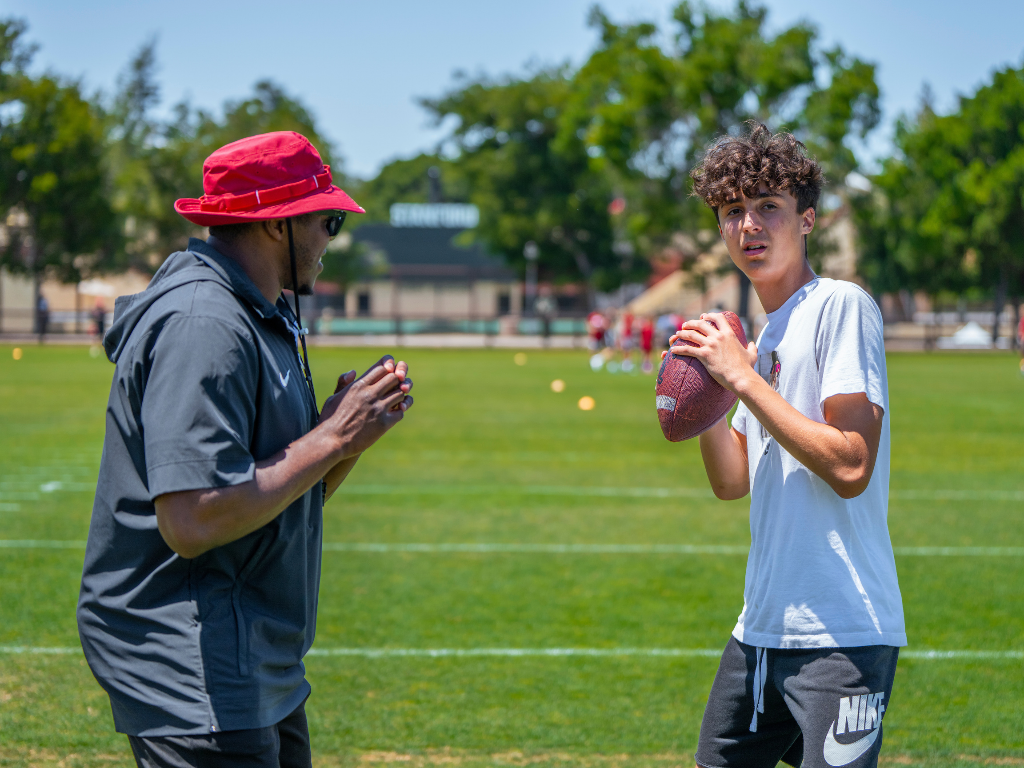
Nike Sports Camps, provided by US Sports Camps
There are roughly 6.5 million youth sports coaches in the United States, and most of them started the same way: someone asked, nobody else raised a hand, and suddenly there was a roster and a first practice on Tuesday.
If that is you, here is the most encouraging fact in the research. In a well-known field study, coaches who attended a single preseason workshop on how to work with young athletes had a 5 percent attrition rate the following year. Coaches who did not had 26 percent. The teams' win-loss records did not explain the difference (Barnett, Smoll and Smith, 1992). One session of preparation, and five times more athletes came back.
You do not need to have played at a high level. You need to run practices where athletes move, learn something, and want to return. This guide covers how to do that in a first season.
The Short Answer
Four things separate a good first season from a rough one, and none of them are tactical:
- Keep athletes moving. Activity time is the most controllable variable in any practice, and standing in line is where seasons go to die.
- Design for repetitions. Small groups, small games, more contacts per athlete.
- Be the reason they come back. Coach behavior, not results, is what athletes remember and what retention data tracks.
- Handle the safety basics before the first whistle. Training, screening, concussion protocol, and an emergency plan.
Winning is a fine goal. It is just not the one that determines whether this works.
What Young Athletes Actually Want
It is worth knowing what you are competing against. Young athletes in the United States play a given sport for less than three years on average, and many quit by age 11 (Aspen Institute Project Play). Understanding why is the most useful thing a new coach can do.
A study of youth soccer players, parents, and coaches identified 81 separate determinants of fun and grouped them into 11 dimensions. The top three were positive team dynamics, trying hard, and positive coaching. Winning ranked 30th out of 81 (Visek et al., 2015).
Read that list again and notice how much of it is within a coach's control. Team dynamics, effort culture, and coaching behavior are the top three drivers of whether an athlete enjoys the season, and all three are things you set.
Designing a Practice That Works
Aim for movement, not management. The clearest benchmark available comes from physical education research, which targets at least half of session time in moderate-to-vigorous activity. A large randomized study across 96 schools raised that from 37 percent to 52 percent of class time, and the proportion of sessions hitting the target went from 21 percent to 73 percent (CATCH). The named enemies of activity time were administrative tasks, waiting for instruction, turn-taking, and elimination games where the athletes who most need practice sit out first.
That last one deserves emphasis. Any game that eliminates athletes removes the ones who need the reps.
Split the group. The single most effective structural change a new coach can make is running more, smaller groups. In a full-sided soccer match a player has the ball about two percent of the time. Split twelve volleyball players into three small-sided games and each athlete gets roughly three times the contacts. Fewer athletes per ball, per basket, per goal, is almost always the right call.
Teach in short doses, then let them play. Explain briefly, demonstrate, and get out of the way. A useful discipline is to time your own talking. Most new coaches are surprised.
Plan one thing per session. Not five. An athlete who leaves practice having improved one thing has had a good practice.
Warm up with the ball, stick, or racquet in hand. Jogging laps is time spent not getting better at the sport.
One myth to discard on the way: the widely repeated rule that a child's attention span is one minute per year of age has no research behind it. It circulates through coaching blogs and nowhere else. Watch your actual athletes instead.
How to Talk to Young Athletes
Positive outweighs negative, though the famous ratio is not what people think. The commonly cited five-to-one praise ratio originated in research on marriages, not coaching, and larger analyses find a linear relationship between positive and negative feedback and good outcomes without any single optimal number. The defensible version: praise more than you correct, make the praise specific and true, and make the correction about the action rather than the athlete.
Support autonomy. A meta-analysis covering 43,675 coaches and athletes found consistent, substantial relationships between coaches supporting athletes' basic psychological needs, athletes' need satisfaction, and self-driven motivation. In practice this means giving athletes choices, explaining the reason behind a drill, and asking questions instead of only issuing instructions.
Praise effort, and name it. "Trying hard" was the second-highest fun dimension in the Visek research. Athletes who are told effort is the standard tend to keep offering it.
Coach the mistake, not the athlete. A useful distinction from goalkeeper coaching applies everywhere: a mistake is random and happens to everyone, while a limitation shows up every time the same situation occurs. After a bad play, the productive question is not what did they do wrong, it is what is preventing this athlete from making that play.
Use their names constantly. It sounds small. It is not.
The Safety Work That Comes Before the First Practice
None of this is optional, and most of it is free.
Abuse prevention training and screening. The Protecting Young Victims from Sexual Abuse and Safe Sport Authorization Act, signed in 2018, requires abuse prevention training for adults in regular contact with minor athletes, mandatory reporting of suspected abuse within 24 hours, and reasonable procedures limiting one-on-one interactions between an adult and a minor athlete unless another adult is within observable and interruptible distance. Whether your specific league falls under the Act depends on its structure, but the practices are the standard everywhere. Background screening guidance from the National Council of Youth Sports recommends renewal at least every two years for adults in direct, repeated contact with young athletes.
Concussion protocol. All 50 states have youth sports concussion legislation. The common elements are immediate removal from play on a suspected concussion with no same-day return, written clearance from a qualified provider before returning, and coach education, which is required in more than 40 states. Return to play is graduated, with a minimum of 24 hours between steps. Learn your own state's specific requirements, because they vary.
An emergency action plan. Venue-specific, reviewed annually, and short enough to fit on one page: emergency contacts, the address and access route for the facility, who does what, and where the nearest AED is. Survival from a shockable cardiac rhythm is best when an AED is used within one to three minutes of collapse, so if your field is further than that from a device, that is a problem to solve before the season, not during it.
First aid, CPR, and AED training. Take the course. It is a few hours.
Heat and hydration. Have a plan for hot days, know the acclimatization guidance for your sport and state, and make water access constant rather than scheduled.
Working With Parents
Parents are not the opposition. The most useful framing comes from iCoachKids: parents are not the enemy, they are the biggest resource at your disposal.
Hold a preseason meeting. Cover how you will communicate, what your goals for the season are, how playing time will be handled, and what you need from them. This is universally recommended and it prevents most of the conflicts that would otherwise arrive by text at 10pm.
Adopt a cooling-off convention. The 24-hour rule, where nobody discusses a game-related concern until a day has passed, is widely used and coaches describe it as giving them room to think rather than react. It is a norm rather than a tested intervention, and it works.
Expect the money question. Research on coach and parent relationships notes that as youth sports costs climb, some parents shift into an investor mindset, where playing time feels like a return on spending. Naming this dynamic honestly at the preseason meeting defuses a lot of it.
Ask them to cheer, not coach. One voice giving instructions during a game is coaching. Three voices is noise.
What to Do About Specialization
You will be asked whether an athlete should focus on one sport. The evidence is fairly consistent, and it points toward sampling.
Position statements from strength and conditioning and sports medicine organizations recommend early participation across multiple sports and broad motor skill development, noting that early specializers show meaningfully higher injury rates and higher dropout. Among Division I lacrosse players, 88 percent of men and 83 percent of women played multiple sports into their teens (USA Lacrosse).
A useful load guideline: pay attention when a young athlete is training more hours per week than their age in years.
As a coach, the practical version is to not schedule your season as though it is the only thing in an athlete's life, and to say out loud that you are glad they play other sports.
Where Nike Sports Camps Fit
Coaching well is a skill, and like any skill it is easier to learn by watching someone do it than by reading about it. One of the most useful things a new coach can do is spend time around experienced coaches ruznning sessions, and pay attention to the mechanics rather than the drills: how they organize a group, how quickly they get athletes moving, how they correct without deflating anyone.
That is a large part of what US Sports Camps has been building for over 50 years. Across Nike Sports Camps, provided by US Sports Camps, coaches are selected based on experience, communication skills, teaching ability, and alignment with youth development best practices, with credentials serving as one of many factors considered. The roster includes collegiate coaches, current and former professional athletes, and experienced high school and club coaches. US Sports Camps sets the standards and quality expectations that camps run to, and handles the logistics, safety procedures, and administration, which is what allows those coaches to spend the week actually coaching rather than managing paperwork.
That model is also the honest answer to a question new coaches ask a lot, which is how camps and clubs differ. Club and travel programs are built around a competitive season, where results accumulate and roster decisions are made. A camp week is built around development, where an athlete can try something, be bad at it for a day, and get better without anything being at stake. Both have value. They are doing different jobs.
A week of camp gives athletes something that can be hard to create during a season: concentrated reps, fresh coaching, and the freedom to experiment without a game or starting spot on the line. They return with new skills, greater confidence, and a clearer sense of what to work on next.
For over 50 years, US Sports Camps has helped athletes of all levels grow their game, build confidence, and love sport through safe, fun, and expertly coached camps.
Find a camp near you at ussportscamps.com.
It Starts Here.