Soccer Tip
How to Become Two-Footed in Soccer: Training Your Weaker Foot
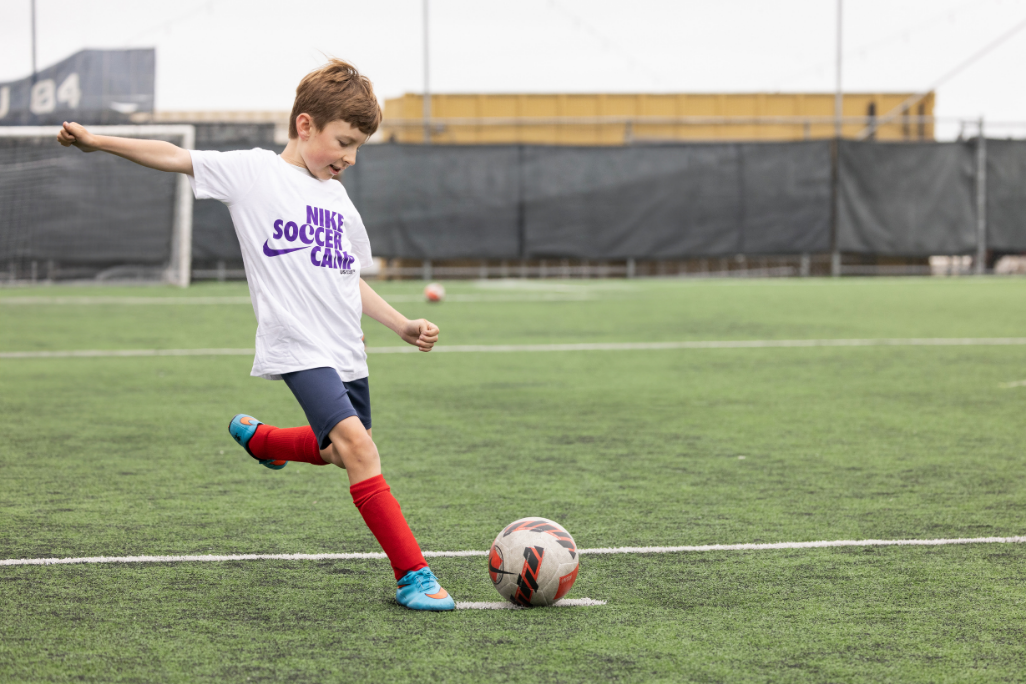
Almost every soccer player has a foot they trust and a foot they hide. You can see it in how they receive a pass, which way they turn under pressure, and how predictable they become in the final third. Defenders can see it too, which is the problem: a one-footed player tells the defender which way they are going before they go.
The good news is that this is one of the most fixable limitations in the sport. Becoming genuinely two-footed is not about talent. It is about volume, patience, and being willing to look bad for a few weeks. This guide covers how to train a weaker foot, in what order, and roughly how long it takes.
The Short Answer
To develop your weaker foot, work through four stages in order:
- Get comfortable touching the ball. Stationary touches, juggling, and toe taps with the weak foot only. Before anything else, the foot has to stop feeling foreign.
- Passing and receiving. Wall work is the single most effective weak-foot tool there is, and it costs nothing.
- Dribbling and turning. Cone work, then moving at speed, then changing direction under light pressure.
- Shooting and crossing. Last, because it requires everything above it to already be in place.
The rule that runs through all four: do far more weak-foot volume than feels reasonable. Most players do a few weak-foot reps and go back to what feels good. Progress comes from ratios like 3:1 in favor of the weaker foot during practice time.
Give it eight to twelve weeks of consistent work before judging the results.
Why It Matters More Than Players Think
It doubles your options. A player who can only go one way has half a pitch available. A two-footed player forces a defender to guess.
It changes what you can be. Full backs who can cross with either foot can play on both sides. Wingers who can go inside or outside are far harder to defend. Midfielders who can receive on the back foot and turn either direction see more of the game.
It speeds you up. The most expensive habit in youth soccer is the extra touch taken to shift the ball onto the strong foot. That touch is often the difference between a shot and a blocked shot, or a pass and a turnover.
It protects you. A player who can only strike with one foot ends up loading one leg for thousands of repetitions. Balance across both sides is better for the body over a long career.
Stage One: Get Comfortable
The goal here is not skill, it is familiarity. Your weaker foot has simply not touched a ball enough times.
Stationary touches. Toe taps, sole rolls, and inside-outside touches, weak foot only, 60 seconds at a time. Do this every day, even if only for five minutes.
Juggling. Start by dropping the ball to your weak foot and catching it in your hands after one touch. Then two. Then five. Juggling with one foot is hard, and it builds the touch and the ankle control that everything else depends on.
Ball mastery patterns. Simple, repeatable sequences with the weak foot, done slowly at first. Focus on the quality of each touch rather than speed.
Expect the first two weeks to feel discouraging. That is the normal experience and not a sign of anything.
Stage Two: Passing and Receiving Against a Wall
If you only do one thing on this list, do this. A wall gives you hundreds of repetitions with instant feedback and no partner required.
Weak-foot passing. Stand eight to ten feet from a wall. Pass with the inside of the weak foot, receive with the same foot, repeat. Two hundred repetitions is not excessive.
One-touch returns. Pass and return in one touch, weak foot only. This forces good body position because there is no time to adjust.
Receiving across your body. Take the return with the inside of your weak foot and move the ball to your other side. This is the technique that lets you turn out of pressure.
Vary the surfaces. Inside of the foot, outside of the foot, and laces. Each has a different use, and most players only ever develop the inside.
Vary the distance. Move back and drive longer passes with the laces. Weak-foot passing range is a separate skill from weak-foot passing accuracy.
Stage Three: Dribbling and Turning
Cone slalom, weak foot only. Five cones, weaving through with only the weak foot. Slow and clean first, then faster.
Figure eights. Two cones, dribbling in a figure eight pattern using only the outside of the weak foot, then only the inside.
Turns. Practice the inside hook, outside hook, Cruyff turn, and drag back with the weak foot. Turning is where one-footed players get exposed most obviously, because a defender who knows you will always turn to your right can simply stand there.
Add light pressure. Once the movement is reliable, have a partner apply gentle pressure. The point at which a skill breaks down under pressure is the point at which real practice begins.
Stage Four: Shooting and Crossing
Save this for last. Shooting with a weak foot before the basic touch is in place teaches a player to swing hard and hope.
Start close and unhurried. Ten yards out, no keeper, focus entirely on the strike. Plant foot beside the ball, ankle locked, contact through the middle of the ball with the laces, follow through toward the target.
Placement before power. Aim for corners at half pace. Power is the last thing to add and the easiest to add.
From a rolling ball. Pass to yourself off a wall and strike the moving ball. Almost every shot in a game is a moving ball.
Crossing. Whipped balls with the inside of the foot, driven balls with the laces. If you play wide, this is where two-footedness pays the most.
Volleys last. They require the most refined ankle control of anything on this list.
A Weekly Structure That Works
You do not need a lot of time. You need consistency and a heavy weak-foot ratio.
| Day | Work | Time |
|---|---|---|
| Daily | Ball mastery and juggling, weak foot | 10 min |
| 3x per week | Wall passing, weak foot only | 15 min |
| 2x per week | Dribbling and turns, weak foot | 15 min |
| 2x per week | Weak-foot shooting | 15 min |
| In games | Deliberately use it in low-risk moments | Ongoing |
That last row is the one people skip and the one that matters most. A player who trains the weak foot alone but never uses it in a game has built a skill they cannot access. Start with the safe moments: a backwards pass, a square ball in your own half, a first touch away from pressure. Trust builds from there.
How Long It Takes
For a committed young player putting in real weekly volume:
- Two to three weeks: the foot stops feeling foreign. Basic passing becomes reliable.
- Six to eight weeks: you can receive, turn, and pass in a game without thinking about it.
- Three to six months: shooting and crossing become genuine options.
- A full season: most teammates and defenders can no longer tell which is your stronger foot.
The single most common reason players never get there is that they stop during the awkward phase. It is worth telling a young athlete that the awkward phase is the training, not an obstacle to it.
What Parents Can Do
Normalize looking bad. A player who is embarrassed to use their weak foot will not use it. Frame the awkwardness as the point.
Ask open questions. "How did you play?" opens a conversation. "Did you use your left?" turns it into an inspection.
Watch the volume, not the outcome. Weak-foot development is a repetitions game. The number of touches is the thing to encourage, and results follow on their own schedule.
Keep it fun. Enjoyment is one of the strongest predictors of whether a young athlete keeps playing, according to research from the Aspen Institute's Project Play. Wall work with a stopwatch and a target score beats wall work as a chore.
Where Nike Soccer Camps Fit
Weak-foot work is repetitive by nature, and the two things that make it stick are volume and someone watching. A week at camp delivers both in a way that a season of one-hour practices usually cannot.
At Nike Soccer Camps, provided by US Sports Camps, athletes get concentrated touches on the ball with collegiate coaches, current and former professional players, and experienced club and high school coaches. Athletes are grouped by age and ability, and coaches are selected based on experience, communication skills, teaching ability, and alignment with youth development best practices, with credentials serving as one of many factors considered.
The environment is part of why camp works for this specifically. On a club or travel team, using your weak foot in a match can cost you the ball, and a player who is worried about their playing time will take the safe touch every time. Clubs increasingly run camps of their own, and many are good, but a camp week with no roster spot on the line is where an athlete can genuinely experiment, be bad at something on purpose, and come out the other side with a skill that changes what kind of player they become.
For over 50 years, US Sports Camps has helped athletes of all levels grow their game, build confidence, and love sport through safe, fun, and expertly coached camps.
Find a soccer camp near you at ussportscamps.com.
It Starts Here.