Swim Tip
Can a Swimming Camp Help You Feel Ready for Your Next Meet?
Yes. A well-run swimming camp prepares you for your next meet by giving you concentrated technique work, race-specific training, and coaching feedback that a normal practice schedule rarely has room for. Most swim seasons are built around maintaining fitness and getting through the meet calendar. Camp flips that structure. For a full week, the only job is getting better: refining your strokes, sharpening your starts and turns, and building the racing confidence that shows up when you step onto the blocks.
Meet readiness has two halves, and camp addresses both. The physical half is technique and race execution. The mental half is knowing, with evidence, that you have done the work. Athletes who leave camp with a cleaner streamline and a faster flip turn also leave with something harder to measure: proof that they can improve when they focus, which is exactly the feeling you want behind you in the ready room.
Where Meets Are Won: Starts, Turns, and Underwaters
The fastest way to drop time in a race is to improve the parts of the race where you are moving fastest: the start, the turns, and the underwater phases. In short-course racing especially, a swimmer can spend a third of the race underwater. Yet during the season, most club practices dedicate limited time to these skills because lane space, practice volume, and meet prep take priority.
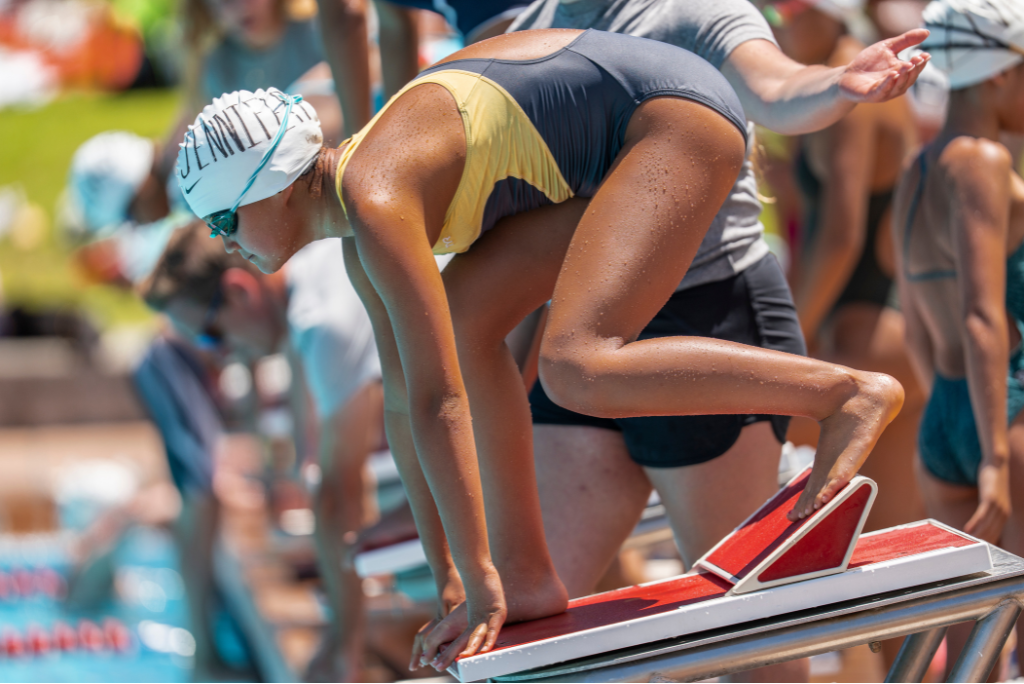
Camp gives these race segments the attention they deserve. A focused week allows for repetition volume that season practice cannot match: start after start off real blocks, turn after turn with a coach watching foot placement and push-off angle, underwater dolphin kick work with immediate correction. These are mechanical skills. They respond quickly to high-quality repetition, which is why swimmers can see measurable improvement in days rather than months.
Stroke Technique Gets Individual Attention
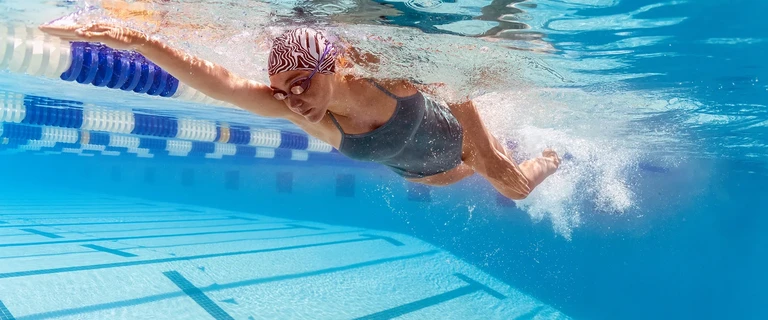
At camp, coaches have the time to watch you swim, identify the specific flaws costing you time, and work with you until the correction holds. During the season, a coach on deck may be responsible for several lanes of swimmers at once. Technique feedback comes in fragments. At a swim camp, the structure is built around instruction: smaller groups, more eyes on each swimmer, and often video review so athletes can see exactly what their catch or body position looks like underwater.
That last piece matters more than most swimmers expect. Feel and reality often disagree in the water. A swimmer who believes their freestyle catch is high and early frequently discovers on video that their elbow drops. Seeing it changes the conversation, and fixing it changes the race.
Technique work at camp typically covers the full picture: body position and balance, catch and pull mechanics in all four strokes, breathing patterns and timing, and stroke-rate awareness for different race distances.
Racing Is a Skill You Can Practice
Camps build meet readiness by treating racing itself as a skill: pacing strategy, warm-up routines, and the mental habits that keep you composed behind the blocks. Plenty of swimmers train well and race below their training. The gap usually comes from racing inexperience: going out too fast in a 100, panicking when a competitor surges, or arriving at the blocks with no routine to settle the nerves.
Good swim camps rehearse all of it. Athletes practice race-pace efforts with intentional splits, learn how to build a pre-race routine they can repeat at any meet, and get coached on what to think about during each phase of a race. Some camps run mock meets so athletes can apply the week's work under a bit of friendly pressure, in an environment where the result costs nothing.
That "costs nothing" part is worth pausing on. During the season, every meet carries stakes: qualifying times, relay spots, seed times. Camp is one of the few places a swimmer can experiment with a new race plan or a revised stroke without risking anything. Trying things is how athletes grow, and camp is built for trying things.
The Confidence Side of Meet Readiness
Confidence before a meet comes from evidence, and a week at camp produces evidence you can point to. By Friday, a swimmer who spent the week on turns has done more quality turn repetitions than they might do in months of regular practice. They may have seen their own video from Monday next to their video from Thursday. The improvement is visible and it belongs to them.
Coaches at camp reinforce this deliberately. Specific feedback ("your breakout was two kicks longer that time, and you held your line") tells an athlete exactly what improved and why it mattered, which is the kind of praise a swimmer can carry into their next race. And because camp mixes hard work with real fun (relay games, team challenges, friendships with swimmers from other clubs), athletes rebuild their enjoyment of the sport at the same time they rebuild their technique. Swimmers who love racing swim faster than swimmers who fear it.
Nike Swim Camps, Provided by US Sports Camps
Nike Swim Camps, provided by US Sports Camps, run at college campuses and training facilities across the country each summer. Camps are led by experienced swim coaches, including collegiate coaches who train swimmers at the D1, D2, and D3 levels. Coaches are selected based on experience, communication skills, teaching ability, and alignment with youth development best practices. Programs typically include stroke technique instruction, starts and turns work, video review at many locations, and training groups organized so each swimmer is challenged at the right level.
Day and overnight options are available at many locations, for athletes ranging from age-group swimmers to high school competitors preparing for championship meets. Visit ussportscamps.com for current locations, dates, and pricing.
Frequently Asked Questions
How close to a big meet should I attend a swim camp?
Most swimmers attend camp in the summer, between seasons, which is the ideal window for technique changes. A stroke adjustment needs time to become automatic before you race with it. If your next meet is more than a few weeks away, camp improvements have time to settle in. If a championship meet is days away, hold your current technique and race it.
Will one week of camp actually drop my times?
One week can produce real, measurable improvement in the mechanical parts of racing: starts, turns, breakouts, and stroke efficiency. Those changes often show up as dropped time at the next meet. The bigger gains come from taking what you learned at camp back to your club training and repeating it for the rest of the season.
I'm not the fastest swimmer in my group. Is camp still for me?
Yes. Camps group swimmers by experience and speed so that every athlete trains at an appropriate level. Improvement at camp is measured against your own Monday, and the swimmers who arrive with the most to learn often leave with the biggest gains.
What should I bring to a swim camp?
Beyond the obvious (suits, goggles, caps, towels), bring any equipment your camp lists, such as fins or a kickboard if requested. Bring a water bottle for deck hydration. Most importantly, arrive with one or two specific goals: a stroke you want fixed or a race skill you want to build. Telling your camp coach that goal on day one makes the whole week more productive.
It Starts Here
Feeling ready for your next meet is a combination of better technique, sharper racing skills, and the confidence that comes from a week of visible improvement. A great swim camp delivers all of it, and you will have fun doing the work, which is the part that keeps swimmers coming back to the pool.
Your next race starts before the whistle. It starts here.
Sources: USA Swimming (usaswimming.org), US Sports Camps (ussportscamps.com)