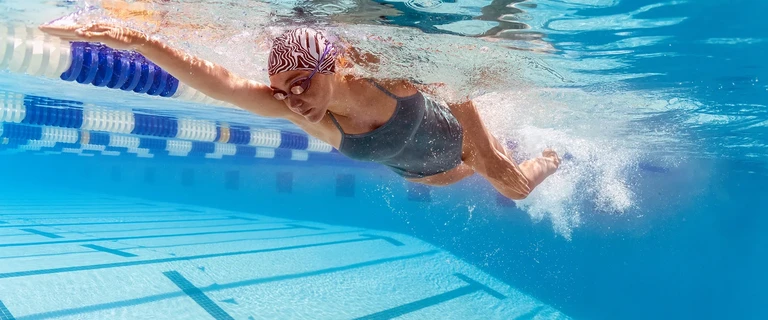
Swim Tip
How to Improve Your Swimming Technique: A Complete Guide to Freestyle
Almost every swimmer who wants to get faster starts in the same place: swimming harder. More laps, more effort, more churn. It works for about two weeks and then stops working, because speed in the water is not mostly a fitness problem. It is a technique problem. Water is roughly 800 times denser than air, which means the swimmer who slips through it cleanly will beat the swimmer who fights it, almost every time, regardless of who is stronger.
This guide covers freestyle technique from the ground up: body position, the catch, the pull, breathing, kick, and the drills that actually change how you move. It is written for young athletes and for the parents helping them get better.
The Short Answer
If you want to improve your swimming technique, work on these six things, in this order:
- Body position. Swim flat and high in the water with your head neutral and your hips near the surface. Nothing else you fix matters as much as this.
- The catch. Get your forearm and hand facing backward early in the stroke, elbow high, before you start pulling. This is where most swimmers lose the most speed.
- The pull. Accelerate through the stroke and finish past your hip. Don't drag your hand through the water at a constant, slow speed.
- Rotation. Rotate from the hips and shoulders together, about 30 to 45 degrees each side. Rotation gives you reach and power; a flat, shoulders-only stroke gives you neither.
- Breathing. Turn your head to breathe, don't lift it. One goggle in the water, one out. Exhale continuously underwater so you only have to inhale when you turn.
- Kick. Small, fast, from the hips, with relaxed ankles. The freestyle kick is mostly about balance and rhythm, not propulsion.
Fix them in that order. A great catch on a swimmer whose hips are dragging is a great catch that goes nowhere.
Body Position: The Thing That Fixes Everything Else
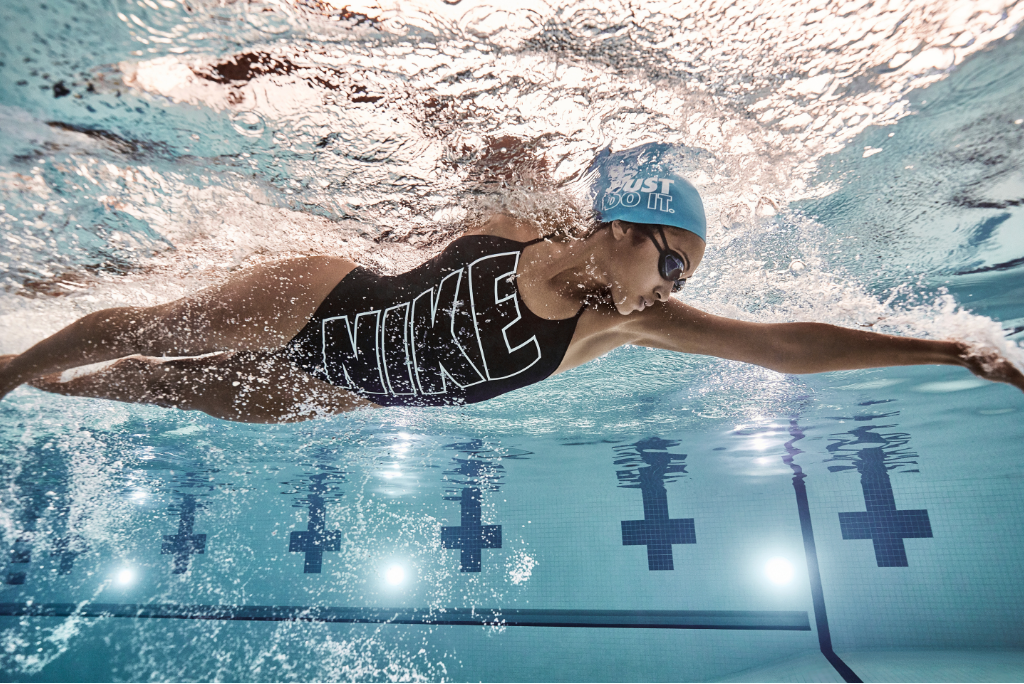
Picture two swimmers. One is level, floating close to the surface, hips just under the water line. The other is angled downward, head up, hips and legs sinking. The second swimmer is dragging a wall behind them for every meter of the pool. No amount of arm strength closes that gap.
Head neutral. Look at the bottom of the pool, not forward. Your head should be an extension of your spine. When you lift your head to look ahead, physics does the rest: your hips drop, and your drag climbs.
Press the chest. Think about leaning gently on your upper chest, as if pressing down on a beach ball. This lever brings your hips and legs up.
Reach long. Extend each arm fully in front of you before the stroke begins. A longer body line is a faster body line, which is why the tallest swimmers rarely have to work as hard.
If your athlete only changes one thing this season, make it this.
The Catch: Where Freestyle Is Actually Won
The catch is the moment after your hand enters the water and before the pull begins. Your job is to set your hand and forearm into a paddle facing backward, while your elbow stays high near the surface.
Most swimmers get this wrong in one of two ways. They either drop the elbow and pull with a straight arm, which pushes water down instead of back, or they rush the catch and start pulling before the hand has anything to hold.
How to feel it: After your hand enters, pause for the smallest instant, then bend at the elbow while keeping the elbow itself high and pointed at the side wall. The hand and forearm should feel like a single flat surface. If you can feel pressure on your forearm, not just your palm, you have it.
Drill: Sculling. Float face down with a snorkel or with your head up, arms extended in front, and move your hands in small figure-eight patterns, feeling the water push back. Two minutes of this teaches more about the catch than an hour of hard swimming.
The Pull: Accelerate, Don't Drag
Once you have the catch, the pull should get faster from start to finish. Slow at the front, fastest at the back, finishing with your thumb brushing past your thigh.
The common error is a constant-speed pull, where the hand moves at the same rate the whole way through. Water responds to acceleration, so a stroke that speeds up moves you more than a stroke that doesn't, even if both take the same effort.
Two more things worth watching:
- Don't cross the midline. Your hand should enter roughly in line with your shoulder, not in front of your nose. Crossing over makes you snake down the lane and puts stress on the shoulder.
- Finish the stroke. A lot of swimmers pull out early, right around the hip. The last portion of the stroke is some of the cheapest speed in swimming, and it is free.
Rotation: Where the Power Comes From
Freestyle is not a flat stroke. Your body should rotate along its long axis, hips and shoulders turning together, roughly 30 to 45 degrees to each side.
Rotation does three things at once. It lengthens your reach, it lets you engage your back and core instead of just your shoulders, and it makes breathing far easier because your mouth is already closer to the surface.
The key detail: hips lead. If your shoulders rotate and your hips stay flat, you have added a twist to your body without adding any power. Think about driving the rotation from the hip on the same side as the arm that is entering the water.
Drill: Six-kick switch. Push off on your side, one arm extended, and kick six times. Then take one stroke and switch to the other side. Six more kicks. This builds the feeling of swimming on your sides rather than on your stomach.
Breathing: Turn, Don't Lift
Breathing is the single most common place where a good stroke falls apart. A swimmer with beautiful technique lifts the head to breathe, the hips drop, the body position collapses, and everything they built resets on every third stroke.
Rotate, don't lift. Turn your head with your body rotation, just enough that your mouth clears the water. One goggle should stay under the surface. There is a small pocket of air in the trough your head creates as you move; you are breathing into that pocket, not above the water.
Exhale underwater. Breathe out steadily through your nose and mouth the whole time your face is down. If you hold your breath and then try to exhale and inhale in the same quick turn, you will always feel behind on air.
Bilateral breathing. Breathing every three strokes, alternating sides, keeps your stroke symmetrical and is worth practicing even if you race breathing to one side.
Kick: Small, Fast, From the Hips
In distance freestyle, the kick contributes far less propulsion than most swimmers assume. Its main jobs are balance, body position, and rhythm.
- Kick from the hips, with only a slight bend at the knee. A bicycle kick from the knees creates drag.
- Keep the kick inside the shadow of your body. Feet breaking the surface and dropping below your torso are both wasted motion.
- Relax the ankles. Flexible ankles are a real advantage in the water, and they respond to stretching.
- Small and fast beats big and slow.
A Simple Practice Structure
A useful technique session looks something like this, and it works for a 10-year-old or a high school swimmer with the distances adjusted:
- Warm up easy. Loosen up. Nothing to prove here.
- Drill work while fresh. Sculling, six-kick switch, catch-up freestyle, single-arm freestyle. Technique work belongs at the start of practice, not the end, because you cannot learn a new movement while exhausted.
- Short, fast repeats with full rest. 25s and 50s at high quality. Speed with good form teaches your body what good form feels like at speed.
- Aerobic swimming with a technique focus. Pick one cue, like "high elbow" or "press the chest," and hold it for the whole set.
- Cool down. Easy swimming, long strokes.
Counting your strokes per length is the cheapest progress tracker in the sport. If you can swim the same time with fewer strokes, your technique improved. That is the whole measurement.
Common Mistakes, and What to Do Instead
| What it looks like | What is happening | The fix |
|---|---|---|
| Legs sinking | Head too high, chest not pressed | Look at the bottom, press the chest |
| Feeling like you're spinning your wheels | Dropped elbow, no catch | Sculling drills, high elbow cue |
| Gasping every breath | Holding breath underwater | Exhale continuously while face is down |
| Zig-zagging down the lane | Hand crossing the midline on entry | Enter in line with the shoulder |
| Sore shoulders | Straight-arm pull, no rotation | Rotate from the hips, high elbow catch |
Where Nike Swim Camps Fit
Technique is hard to fix alone, because the two things you most need are a coach who can see what you cannot feel, and enough water time to make the correction stick. That is exactly what a week at camp gives an athlete.
At Nike Swim Camps, provided by US Sports Camps, athletes work with collegiate coaches, current and former professional swimmers, and longtime club coaches who spend the week on stroke mechanics: video review, drill progressions, and the kind of individual feedback that is hard to get in a crowded lane during the season. Coaches are selected based on experience, communication skills, teaching ability, and alignment with youth development best practices, with credentials serving as one of many factors considered.
Camp is also a different environment from a club team, and that difference matters. There is no roster spot to protect and no meet on Saturday. An athlete can rebuild their catch badly for three days, feel slow, and come out the other side faster, without any of it costing them. That freedom to experiment is where technique changes actually happen.
For over 50 years, US Sports Camps has helped athletes of all levels grow their game, build confidence, and love sport through safe, fun, and expertly coached camps. Swimming is a sport where a single week of good coaching can reset an athlete's next two years.
Find a swim camp near you at ussportscamps.com.
It Starts Here.