Volleyball Tip
What Your Child Will Learn at Volleyball Camp
Parents who have never played volleyball often wonder: what exactly happens at camp? What will my child actually come home knowing? This guide breaks down the skills, habits, and lessons that a well-run volleyball camp teaches, so you can evaluate programs with confidence and set realistic expectations for your athlete.
The Foundational Techniques Every Camp Covers
Every quality volleyball camp covers the same core technical foundations: serving, passing, setting, attacking, blocking, and defense. What separates strong programs from average ones is the depth of instruction and the quality of individual feedback athletes receive.
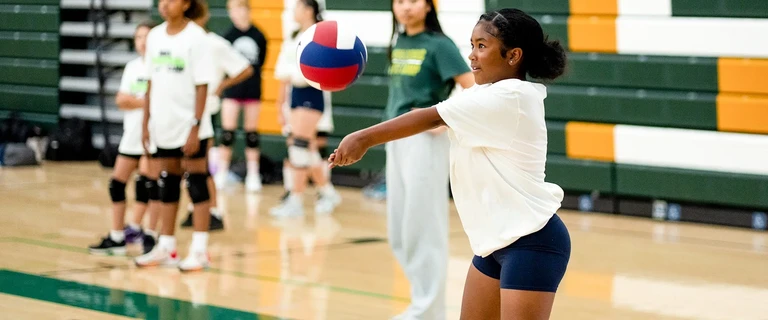
On serving, athletes learn float and topspin mechanics, starting from the platform position and building to consistent, accurate delivery. Passing instruction covers platform angle, footwork, and how to read the ball off the net or the serve. Setting instruction focuses on hand position, timing, and directing the ball to specific targets. Attack work covers full approach footwork, arm swing mechanics, and how to adjust mid-air based on the set. Defense instruction covers reading hitters, positioning, and ball control under pressure.
Beyond Technique: The Skills That Last Longest
The technical skills are visible. The habits that stick longest are less obvious but often more important: communication on the court, accountability for positioning errors, staying focused after a mistake, and the competitive instinct to go after a tough ball.
Camp creates the repetitions that build these habits. In a regular school or club season, athletes practice a few hours each week and play one or two matches. Camp concentrates that work: athletes get touches all day across skill stations, position work, and competitive play, which adds up to more focused repetitions in a single week than many athletes see in a month of regular season play. That concentration of reps accelerates development in ways a regular season simply cannot replicate.
Position-Specific Work
Many volleyball camps include position-specific training, especially for older or more experienced athletes. Liberos work on defensive reading and quick lateral movement. Setters work on decision-making and consistency across different approach speeds. Outside hitters work on shot selection and timing across different set types. Middle blockers work on blocking reads and fast-tempo attack approaches.
Position-specific work is valuable for athletes who have already identified where they want to play. For younger athletes still exploring the game, generalist instruction covering all positions gives them the foundation to make that decision later with real information.
Team Skills: Communication, Coverage, and Composure
Volleyball is a team sport, and strong camps develop the habits that make athletes better teammates: calling the ball, communicating defensive assignments, backing up teammates on every play, and resetting mentally after an error.
These aren't secondary to skill development. Research from Aspen Institute's Project Play consistently shows that athletes who develop positive team habits in structured environments carry those habits into school, relationships, and later athletic contexts. The best volleyball camps treat communication and composure as training priorities, not afterthoughts.
The Camp Experience That Differs from Club Season
Athletes who participate in club volleyball often arrive at camp carrying the habits of a competitive season: protecting their weaknesses, playing it safe, managing impressions. Camp is designed to undo that. The low-pressure environment, where no one is evaluating your spot on a roster, creates space for athletes to experiment.
A setter who has only been setting one style of offense can spend a whole day working on a different tempo. A back-row player who struggles at serve-receive can take the full session on that skill without worrying about what the coach thinks. That freedom accelerates development in ways that competitive environments don't naturally allow.
What to Ask Your Child Before and After Camp
Before camp starts, help your athlete identify one or two specific things they want to work on. "What do you want to get better at this week?" is a simple question that gives them something to focus on when the coaching happens.
After camp, ask open-ended process questions: how did you play? What did you try that felt different? What's one thing you want to keep working on? Questions focused on process, rather than outcomes or scores, reinforce the growth mindset that makes camp improvement stick long after the week ends.
About Nike Sports Camps, Provided by US Sports Camps
Nike Sports Camps, provided by US Sports Camps, offers volleyball programs designed to develop athletes at every level. Coaches bring backgrounds ranging from Division I collegiate programs to professional and international competition, and are selected for their ability to teach young athletes effectively.
Visit ussportscamps.com/volleyball to find programs near you. It Starts Here.