Football Tip
Can a Football Camp Improve Your Technique and Confidence?
Yes. A football camp improves your technique through position-specific instruction and high-repetition skill work, and it builds confidence by letting you master those skills in a setting where no roster spot is on the line. During the school season, practice time belongs to the team: installing plays, preparing for opponents, running the depth chart. Your individual development gets whatever minutes are left over. Camp reverses that. For a week, the entire schedule is organized around making you a better football player.
That difference in structure explains why athletes often improve faster in one week of camp than in a month of team practice. Every drill is chosen for skill development. Every repetition gets coached. And because camp carries none of the competitive pressure of a season, athletes are free to work on their weaknesses instead of hiding them.
Position-Specific Technique, Taught Properly
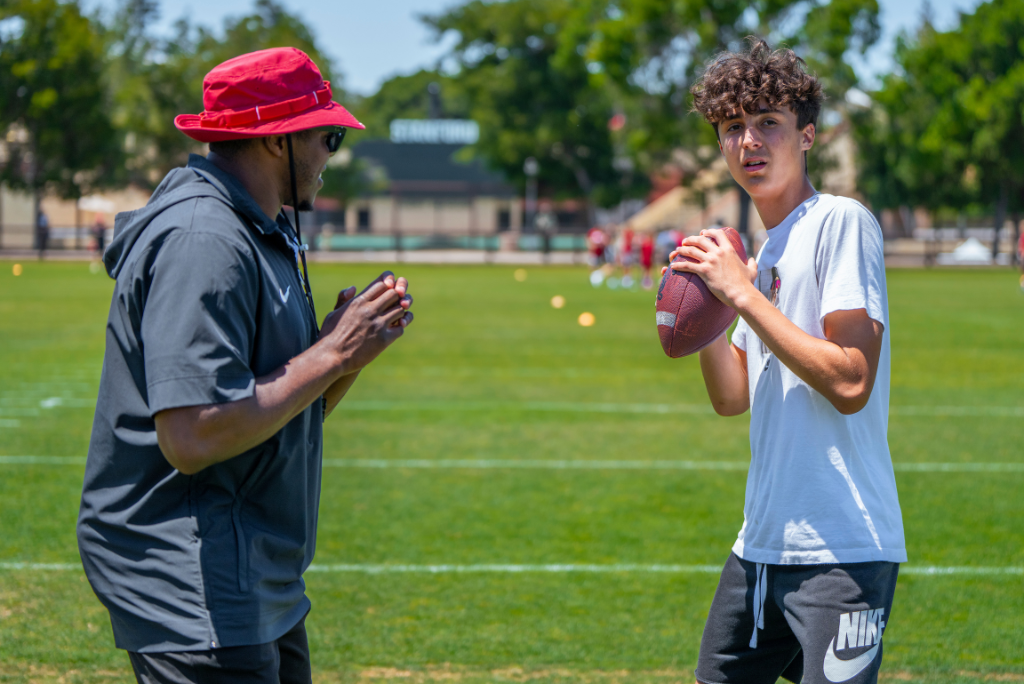
Camp is often the first place a young football player receives detailed instruction for their specific position, taught by a coach who specializes in it. On many youth teams, one or two coaches cover the entire roster. A quarterback learns footwork from a coach who is also managing the offensive line. At a football camp, athletes typically split into position groups led by coaches with deep experience at that spot.
What that looks like in practice depends on where you line up:
- Quarterbacks work on footwork and drops, throwing mechanics, reading coverage, and decision speed.
- Receivers and running backs work on route running, catching technique, ball security, and creating separation.
- Linemen work on stance, first-step quickness, hand placement, and leverage.
- Defensive players work on backpedal and hip turns, tackling technique, block shedding, and pursuit angles.
Learning proper technique early matters for performance and for safety. Sound mechanics protect athletes. Camps that teach technique through a careful progression (positioning and footwork first, then controlled application) help athletes build physical skills the right way from the start.
Why Repetition Volume Changes the Math
A football camp compresses hundreds of coached repetitions into a few days, and coached repetition is the raw material of technique. Consider a receiver who runs eight or ten routes with feedback during a normal team practice. At camp, that same receiver might run dozens of routes a day, each one watched, several of them corrected. Multiply that across a week and camp delivers a season's worth of individual coaching in five days.
The correction is the key ingredient. Repetition without feedback just makes your current habits more permanent, including the bad ones. Camp coaches interrupt that cycle: they spot the false step, the low elbow, the drifting route, and they fix it while there is time to build the new habit through more repetitions the same day.
Confidence Comes From Demonstrated Ability
Football confidence is built the same way football skill is built: through repeated proof that you can execute when it counts. Sports research on youth athletes consistently points to what psychologists call a mastery climate, an environment where improvement is celebrated over outcomes and mistakes are treated as information, as the strongest driver of athletic confidence. A good football camp is a mastery climate by design.
Athletes at camp attempt things they have never tried, fail at some of them in front of their peers, get coached, try again, and succeed. That loop, repeated all week, changes how an athlete carries themselves. The receiver who finally beats press coverage on Thursday walks into their fall season knowing they can do it, because they already have.
Camp also removes the fear that quietly limits development during the season. On a team, many athletes avoid working on weaknesses because struggling in practice can cost playing time. Camp has no depth chart. An athlete can spend the whole week attacking the one skill that scares them, which is exactly the work that produces the biggest jumps.
The Fun Is Part of the Formula
Athletes improve fastest in environments they enjoy, and a great football camp is built to be one of the best weeks of the summer. Competition periods, seven-on-seven tournaments, position group rivalries, and the friendships that form between athletes from different schools all feed the same outcome: athletes who are having fun stay engaged, take more repetitions, and come back for more. Development and enjoyment work together at camp, and the best coaches never treat them as separate goals.
Nike Football Camps, Provided by US Sports Camps
Nike Football Camps, provided by US Sports Camps, offer contact, skills (non-contact), and flag camps for athletes across skill levels, from first-year players to varsity competitors. Coaches are selected based on experience, communication skills, teaching ability, and alignment with youth development best practices; camp staffs include current and former collegiate coaches and players with experience at the D1, D2, and D3 levels. Formats range from day camps focused on skill development to overnight camps at college campuses.
Visit ussportscamps.com for current locations, dates, and pricing.
Frequently Asked Questions
Are football camps full contact?
Many football camps, including most skills-focused camps, are non-contact, where instruction centers on technique, footwork, and position-specific skills. Full contact or limited-contact camps focus on teaching proper technique and tackling form and offers campers more physical competition that simulates real game scenarios more closely. Check the specific camp's format before registering, and ask the camp directly if the description is unclear.
What age should a football player start attending camps?
Athletes commonly start attending football camps in elementary and middle school, when the focus is fundamentals and fun. The right starting age depends more on the athlete's interest than the calendar. If they are excited to play and ready to spend a day being coached, they are ready for a beginner-friendly camp.
Can one week of camp really change my season?
One week can correct technique flaws, add new skills, and send you into the season with momentum and confidence. What carries the improvement forward is repetition after camp: the athletes who keep drilling what they learned are the ones whose fall season looks different.
I play multiple sports. Is a football camp still worth it?
Yes, and playing multiple sports is worth protecting. Research from the Aspen Institute's Project Play supports multi-sport participation for young athletes. A week of football camp lets a multi-sport athlete develop football skills intensively without committing to a year-round program.
It Starts Here
Better technique is coached, and confidence is earned through repetitions that prove what you can do. A football camp gives you a full week of both, alongside athletes who push you and coaches who know how to get the best out of you, with plenty of fun built into every day.
Your best season starts before the season. It starts here.
Sources: USA Football (usafootball.com), Aspen Institute Project Play (aspenprojectplay.org), US Sports Camps (ussportscamps.com)